
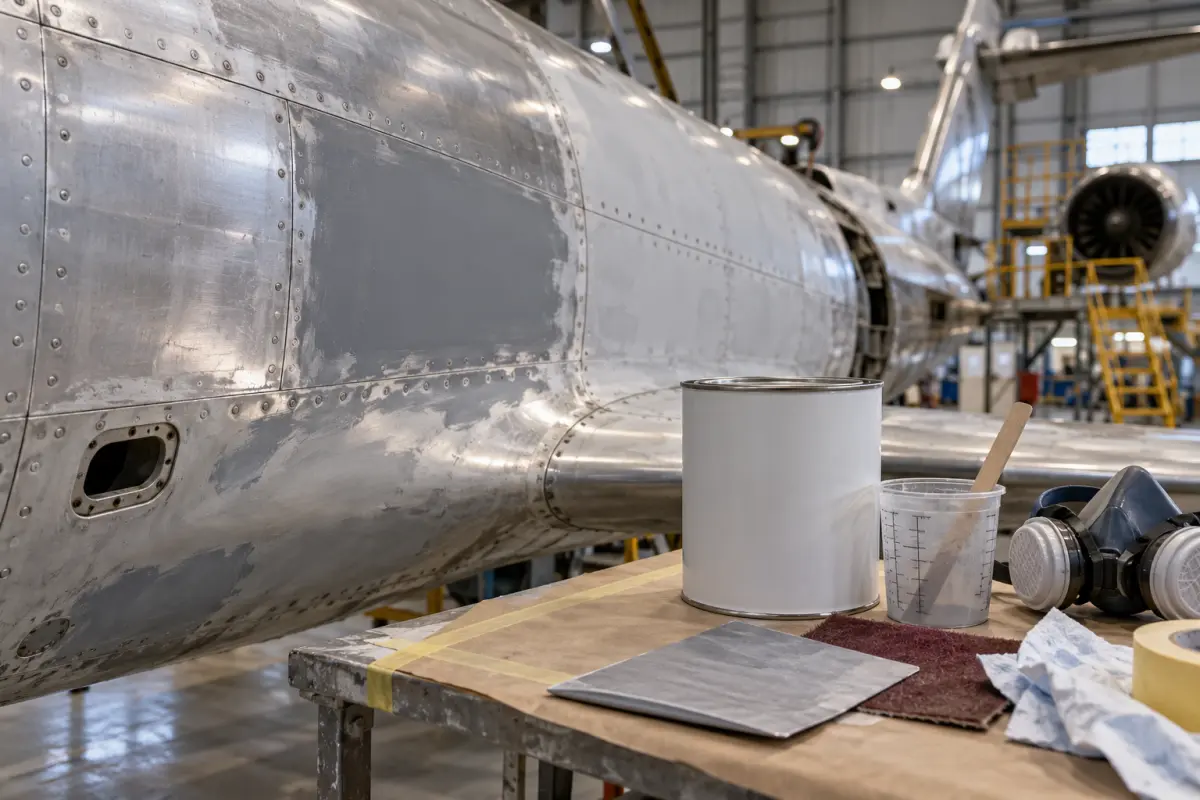
Epoxy Primer for Aircraft: Selection and Sourcing Guide
Epoxy primer for aircraft is a preparatory coating used to promote adhesion and help protect a surface beneath a compatible topcoat or other finishing layer. Selecting one for maintenance or production means matching the primer to the substrate, coating system and documented job requirements—not choosing by the term “epoxy primer” alone.
Key Takeaways
- Aircraft epoxy primers are not interchangeable simply because they share the same coating chemistry.
- Start with the substrate and the specified coating system, then identify the exact primer part number.
- A primer sold as a kit may require both components to be identified in a purchase request.
- Product descriptions are useful for shortlisting; the controlling maintenance and product documents determine suitability.
What an Aircraft Epoxy Primer Does
An epoxy primer forms an intermediate layer between a prepared aircraft surface and subsequent coatings. Depending on its formulation and intended system, it can support adhesion, corrosion protection and resistance to fluids encountered in service. The primer is part of a coating system: its value depends not only on the primer itself but also on the surface beneath it and the coating applied over it.
That distinction matters in purchasing. A primer intended for aluminum exterior work is not automatically the right choice for a composite surface or a small structural detail. Likewise, the fact that two primers can accept a polyurethane topcoat does not establish that they belong to the same qualified system. Buyers should treat the specified product identity as a requirement, rather than substitute another epoxy primer based on a similar description.
Epoxy primer also serves a different role from a topcoat. A primer prepares and protects the underlying surface within the specified system; a topcoat provides the exposed finish. For a broader comparison of coating roles, see CraftJetAero’s guide to aircraft primer types.
How the Listed Primer Options Differ
The examples below illustrate why a buyer should compare intended use and product identity before requesting a quote. They are distinct listings, not a list of approved substitutes for one another.
| Listed part number | Brand | Use described in the product listing | Purchasing distinction |
|---|---|---|---|
| 10P4-3NF/EC-117 | AkzoNobel | Aircraft detail and subassembly parts; a base for epoxy and polyurethane topcoats | Identify the complete primer designation, including the suffix. |
| 10P4-2NF/EC-117S | AkzoNobel | Critical structural components; corrosion protection and fluid resistance | Do not confuse its similar-looking designation with 10P4-3NF/EC-117. |
| 515X349-910X533 | PPG Aerospace | Exterior aluminum applications; compatibility with DeSothane HS topcoats | Preserve both identifiers in the listed product designation. |
| BR6747-1/20% | Solvay | Water-based epoxy primer for aluminum and metal substrates | Include the full slash-and-percentage designation when requesting it. |
| 512X310-910X533 | PPG Aerospace | Composite aircraft surfaces | Specify the complete listed kit designation, not only one component identifier. |
For example, the listing for PPG 515X349-910X533 exterior epoxy primer describes an aluminum application and compatibility with DeSothane HS topcoats. By contrast, the listing for PPG 512X310-910X533 describes a primer for composite aircraft surfaces. Both are epoxy primers, but those descriptions point buyers toward different questions about substrate and finishing requirements.
Match the Primer to the Substrate and Coating System
Begin with the work location: is the primer needed on an exterior aluminum surface, a composite area, a structural component or a detail part? Record the substrate and the finish that will follow. A request stating only “aircraft epoxy primer” omits the information most likely to distinguish one listing from another.
Next, establish whether the task calls for a specific primer and topcoat pairing. The AkzoNobel 10P4-3NF/EC-117 listing, for instance, describes a base for epoxy and polyurethane topcoats on detail and subassembly parts. That broad description does not identify every compatible topcoat or every permitted aircraft application. A complete coating-system requirement is more informative than a generic request for “epoxy plus polyurethane.”
Consider the formulation only after the application is clear. The Solvay BR6747-1/20% listing describes a water-based, zero-VOC epoxy primer for aluminum and metal substrates. Those characteristics distinguish it from the other examples, but they do not make it a direct replacement for a primer specified elsewhere. Similarly, the listing for 10P4-2NF/EC-117S describes a lead- and cadmium-free primer for structural components. Formulation details help refine a search; they do not replace the exact system requirement.
One short verification rule covers every option: follow the aircraft maintenance documentation and the primer manufacturer’s current data sheet for surface preparation, mixing, application and overcoating, and confirm any required approvals and airworthiness implications before using a product or accepting a substitution.
What to Put in a Procurement Request
A precise request reduces clarification cycles between maintenance, purchasing and the supplier. Use the part number as written in the work requirement, retaining slashes, hyphens and suffixes. Where a listing combines identifiers, include the complete designation and state the required kit configuration rather than assuming that one identifier names the entire purchase.
- Exact identity: manufacturer or brand, full part number and any specified kit configuration.
- Job context: substrate, aircraft area and intended coating system, if known.
- Documentation needed: the product data and transaction documents your receiving or quality process requires.
- Order details: requested quantity, packaging requirement and destination for the quotation.
For example, a buyer might write: “Please quote AkzoNobel epoxy primer, part number 10P4-2NF/EC-117S, in the required package configuration. The request is for a structural-component coating task; please identify the product documentation available for review.” This is clearer than asking for “Akzo epoxy primer,” especially because the listings also include the differently designated 10P4-3NF/EC-117.
When a part number is copied from a work card, verify each character before sending it. On the listed PPG examples, 515X349-910X533 and 512X310-910X533 share the second identifier but differ in the first. Omitting that first identifier would make the request ambiguous. The same discipline applies to suffixes such as “S” and to punctuation within a designation.
Sourcing from CraftJetAero
CraftJetAero lists aircraft epoxy primers among its aviation chemical products. Buyers can request a quote by part number through CraftJetAero’s contact page; including the full designation, required configuration and job context helps define the request.
Frequently Asked Questions
Is epoxy primer for aircraft the same as a topcoat?
No. The primer is an underlying coating within a finishing system, while the topcoat is the exposed finishing layer. The two have different roles and should be identified separately in a purchase request.
Can one aircraft epoxy primer be used on both aluminum and composites?
Do not assume so from the words “epoxy primer.” The listed PPG 515X349-910X533 is described for aluminum, while 512X310-910X533 is described for composite aircraft surfaces.
Why does an epoxy primer designation sometimes contain two identifiers?
A listing may use a combined designation to identify a supplied product or kit, as in 515X349-910X533. Keep the full designation in the request so the supplier can identify what is being quoted.
Are 10P4-3NF/EC-117 and 10P4-2NF/EC-117S interchangeable?
No interchangeability is established by their similar names. Their listings describe different use contexts, so a buyer should request the exact primer specified for the task.
What is the first question to ask when selecting an aircraft epoxy primer?
Ask which substrate and coating system the job calls for. That answer narrows the search more effectively than starting with a brand or a general claim such as corrosion resistance.