
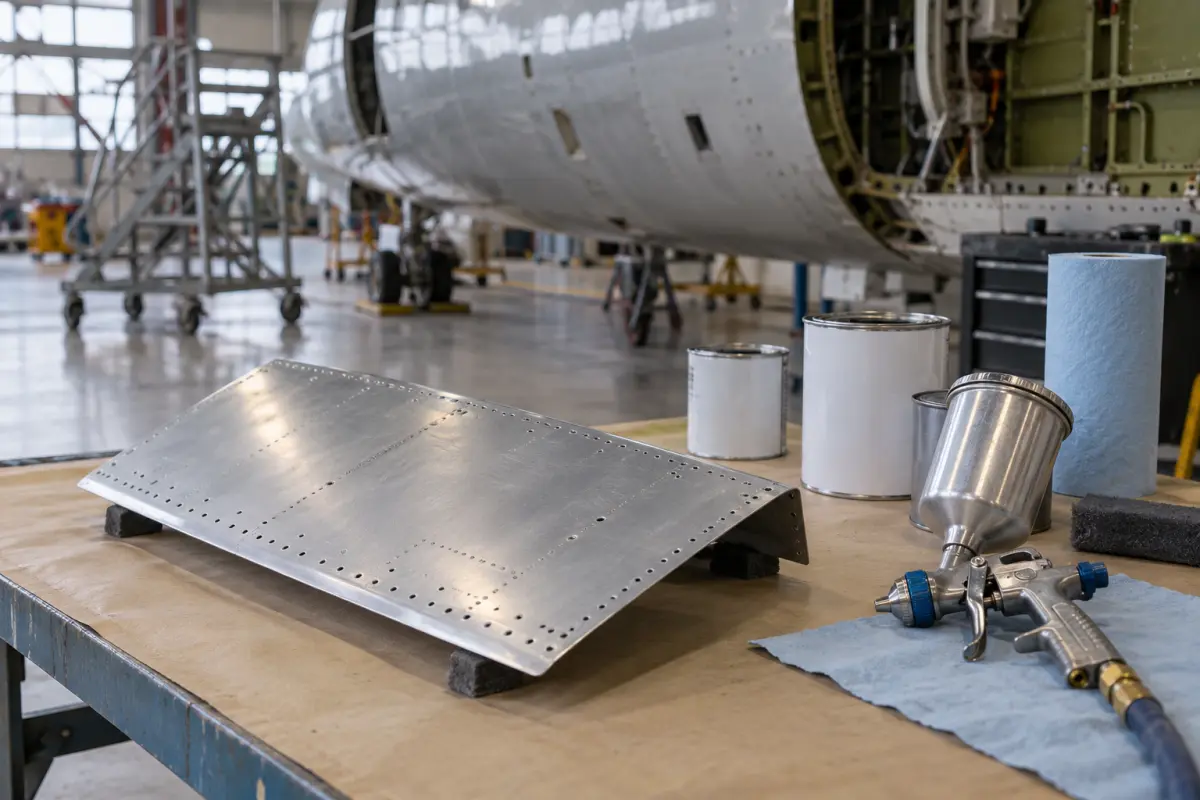
Aircraft Primer Types: How to Choose for Maintenance
Aircraft primer types include epoxy and urethane coating primers, as well as specialty primers used to promote adhesion or meet a particular application need. For maintenance buyers, the useful distinction is not just the primer’s name: it is what the primer is intended to cover, what will be applied over it, and which exact product the maintenance documentation calls for.
Key Takeaways
- Epoxy and urethane describe primer chemistries; neither label identifies a universally interchangeable product.
- A coating primer and a sealant-adhesion primer serve different purposes.
- Substrate, exposure, topcoat and application method help narrow the choice, but the required part number controls the purchase.
- For a useful quote request, provide the complete primer part number and identify any required kit components.
Aircraft Primer Types at a Glance
Primer is an intermediate material applied before another layer, but that broad definition covers several different jobs. A coating primer may prepare a surface for a finish coat and contribute to corrosion protection. An adhesion primer may instead prepare a surface for a sealant. Buyers should distinguish the intended job before comparing products that are all listed simply as “primer.”
| Primer type | Typical selection question | Example from the supplied product listings |
|---|---|---|
| Epoxy coating primer | Is an epoxy primer specified for the substrate and subsequent coating? | AkzoNobel 10P4-3NF/EC-117 is described for aircraft detail and subassembly parts and as a base for epoxy and polyurethane topcoats. |
| Urethane coating primer | Is a urethane primer specified for the exterior coating system or another defined application? | AkzoNobel 10P20-44MNF/EC-291B/TR-114 is described as a high-solids urethane primer for aircraft exteriors. |
| Adhesion primer | Is the next material a sealant or coating that calls for surface priming? | DOWSIL PR-1200/Red is described as a one-part primer that enhances adhesion on several substrate types. |
| Application-specific primer | Does the task require a particular property or application format? | PPG 825-009-910-175-020-044 is described as a high-temperature urethane primer for aircraft surfaces. |
The table is a way to organize a search, not a substitution guide. Two products can share a chemistry while differing in intended substrate, coating compatibility, supplied components and application instructions.
Epoxy Primers: A Common Coating-System Starting Point
Epoxy primers are a familiar category in aircraft finishing and maintenance because products in this family can be formulated for adhesion, corrosion protection and use beneath specified topcoats. The word “epoxy,” however, does not tell a buyer whether a particular product belongs on an interior detail, an exterior aluminum surface or a bonding-related application.
For example, AkzoNobel epoxy primer 10P4-3NF/EC-117 is described for aircraft detail and subassembly parts, with epoxy and polyurethane topcoats identified as subsequent coatings. By contrast, PPG DeSoto exterior epoxy primer 515X349-910X533 is described for aluminum substrates and integration with DeSothane HS topcoats. Both are epoxy primers, but their descriptions point buyers to different application details to check.
Another distinction is formulation. Solvay BR6747-1/20% is listed as a water-based, zero-VOC epoxy primer for aluminum and other metal substrates. That description can help a buyer identify the requested family, but it does not make the product a replacement for a different epoxy primer. Record the complete identifier rather than shortening a request to “aircraft epoxy primer.”
Urethane Primers: Check the Intended Coating System
Urethane primers are another coating-primer category. When comparing them with epoxy primers, focus on the specified coating system and use rather than assuming one chemistry is inherently preferable. A primer intended for an aircraft exterior, for example, may have a different role from one selected for a defined high-temperature area.
The listing for AkzoNobel urethane primer 10P20-44MNF/EC-291B/TR-114 describes a high-solids product for aircraft exteriors, with adhesion to urethane coatings and Skydrol resistance noted. PPG 825-009-910-175-020-044 is also listed as a urethane primer, but its description identifies a high-temperature application and states resistance to temperatures up to 232°C (450°F). That temperature is a claim for that identified product, not a general property of urethane primers.
In a purchase request, “urethane primer for an exterior” is therefore useful context, not a complete specification. Include the identifier and any separately identified base, activator or other kit component required by the requested product.
Specialty and Adhesion Primers: Define What Goes on Next
Some products called primers are selected primarily to support adhesion rather than to act as the first layer of a conventional paint system. DOWSIL PR-1200/Red, for instance, is described as a one-part primer that enhances adhesion on metals, ceramics, glass, masonry and select plastics. Its listing refers to sealants and coatings; it should not be treated as another name for an epoxy aircraft coating primer.
Other listings emphasize a particular application feature. PPG 76413600-KAHA is identified as a P99 Yellow Primer Base with a two-pack formula and ambient curing. The word “base” matters to procurement: it signals that a buyer should confirm the complete system being requested rather than assuming the listed base alone describes everything needed for the job.
If the work involves sealing, first establish whether the task calls for an adhesion primer and a compatible sealant, or for a coating primer used elsewhere in the assembly. The materials can appear in the same maintenance environment without performing the same function.
How to Turn a Maintenance Requirement Into a Buying Request
A practical selection process starts with the work package, not a catalog filter. Once the required material is identified, the buyer can use the product description to check that the requested identifier and application context align.
- Identify the task and surface. Note whether the work concerns a detail part, exterior panel, bonded area or sealant application, and record the substrate stated in the task.
- Identify the next layer. Record the specified topcoat, sealant or other material that will contact the primer.
- Capture the exact identifier. Preserve letters, numbers, suffixes and separators. Similar-looking identifiers should not be merged into a generic description.
- Clarify the purchasing unit. State whether the request is for a named base, a kit or specified components, and include the required package size if the work order provides one.
- Resolve gaps before ordering. If the work package names only a primer family, ask the engineering or maintenance team for the required product and configuration.
For example, a buyer might write: “Please quote AkzoNobel 10P4-3NF/EC-117 epoxy primer for the aircraft detail-part task. Confirm the quoted product identifier and supplied components against the requested configuration.” That is more actionable than “quote corrosion-resistant aircraft primer,” which could describe several different products.
Use only the primer and process permitted by the applicable aircraft maintenance documentation and approvals; verify surface preparation, mixing, application and overcoating instructions in the manufacturer’s current data sheet before use. A catalog description alone does not establish airworthiness or authorize a substitution.
Sourcing from CraftJetAero
Buyers can request a quote from CraftJetAero by complete part number through the CraftJetAero contact page. Include the product identifier, requested configuration and any purchasing details needed to distinguish the item.
Frequently Asked Questions
What are the main aircraft primer types?
Common categories include epoxy and urethane coating primers, along with primers intended to promote adhesion for a particular sealant or coating. The required application determines which category is relevant.
Is epoxy primer interchangeable with urethane primer?
No. Chemistry alone does not establish interchangeability; the substrate, subsequent coating and specified product all matter.
Is a sealant primer the same as a paint primer?
Not necessarily. A sealant-adhesion primer prepares a surface for a specified sealant system, while a coating primer is used within a paint or protective coating system.
Why does the full primer part number matter?
The complete identifier distinguishes the requested product and configuration more reliably than a broad phrase such as “epoxy aircraft primer.” Suffixes and component designations should be carried through into the quote request.
Can a product listing confirm that a primer is approved for a repair?
No. A listing helps identify a material, but the applicable maintenance documentation and approval requirements govern its use for a particular aircraft task.