
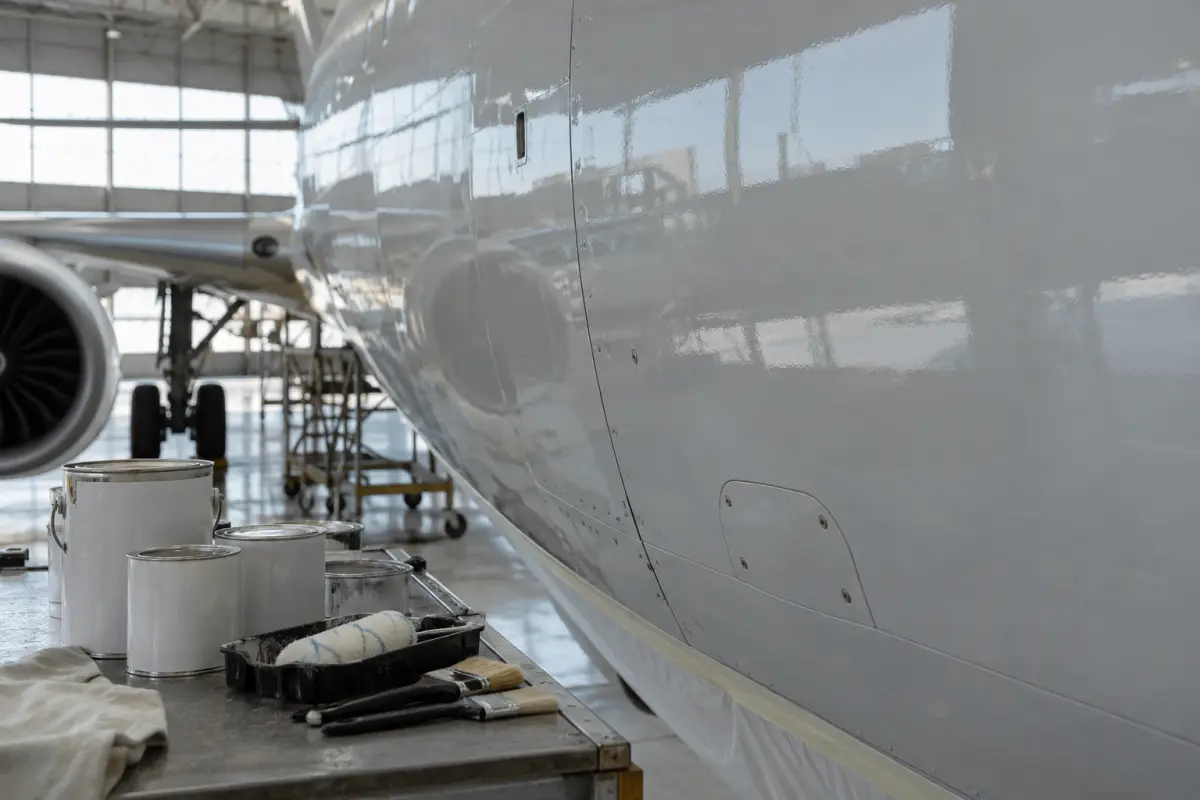
Aircraft Topcoat Paint: Types, Uses and Buying Guide
Aircraft topcoat paint is the finish coating applied over a prepared substrate or compatible primer to provide the specified color, appearance, and surface protection. The right choice depends on where the coating will be used, the required finish, the underlying coating system, and the exact product identified in the maintenance documentation.
Key Takeaways
- A topcoat is a finish layer; a primer prepares and protects the surface beneath it.
- Epoxy and polyurethane topcoats are different product families, not interchangeable descriptions.
- Exterior finishes, internal structures, and walkways can call for different coating properties.
- A useful quote request identifies the part number, color, kit or package requirement, and application location.
What Does Aircraft Topcoat Paint Do?
In an aircraft coating system, the topcoat is the exposed finish layer. It establishes the visible color and sheen where appearance matters and helps protect the coated surface in its intended environment. The word “topcoat” describes the layer’s role, not a single chemical formulation: an aircraft topcoat may be an epoxy or polyurethane product.
Location is a useful starting point for selection. An exposed exterior panel may need a specified color and finish that remains presentable in service. An internal metal structure may place greater emphasis on chemical resistance than appearance. A walkway needs a surface intended for foot traffic rather than an ordinary smooth decorative finish. These are different purchasing requirements even when all three items are described casually as “paint.”
It also helps to separate a coating’s job from the rest of the surface-preparation process. A topcoat does not replace cleaning, preparation, or a specified primer. For example, 10P4-3NF/EC-117 epoxy primer is described as a base for epoxy and polyurethane topcoats on aircraft detail and subassembly parts. That makes it a primer to identify within a coating system, not an alternative name for the finish coat.
Epoxy vs. Polyurethane Aircraft Topcoats
Both families can serve as finish coatings, but the label alone does not establish that a particular product suits a particular aircraft surface. Start with the specified coating system and use the product description to distinguish candidates by intended application. The examples below show why buyers should request an exact part number rather than simply asking for “aircraft paint.”
| Coating family | Example from the listed products | Described application or finish | Buying distinction |
|---|---|---|---|
| Epoxy topcoat | EC75-801-KBH0 | Black epoxy topcoat described for metal surfaces and chemical resistance | Identify the required color and exact product, not just “epoxy paint.” |
| Epoxy topcoat | MAPAERO-F69-BLUE | Blue epoxy finish described as semi-gloss | Confirm that the named color and finish match the requirement. |
| Polyurethane topcoat | 8000-B70180-KCH0 | Topcoat described for aircraft exteriors, with gloss and color retention | Specify the complete identifier for the requested exterior finish. |
| Special-purpose polyurethane coating | AVIOX-NON-SLIP-M8001 | Non-slip coating described for walkways and cargo floors | Do not substitute an ordinary smooth topcoat for a non-slip requirement. |
For a concrete comparison, EC75-801-KBH0 black epoxy topcoat and 8000-B70180-KCH0 polyurethane topcoat are both finish coatings, but their listed descriptions point to different priorities: the former emphasizes protection of metal surfaces in demanding environments, while the latter is presented for aircraft exteriors. Neither description, by itself, makes one a substitute for the other.
Match the Coating to the Surface and Finish
“Aircraft topcoat paint” is a useful search term, but it is too broad for a precise purchase order. Narrow the requirement in a consistent order: application area, coating family, color and sheen, exact identifier, and package or kit configuration. If an existing coating is being replaced, record the identifier on the approved work package or material list before searching by a general product description.
- Exterior surfaces: State the aircraft area and the required color and finish. The listed 8000-B70180-KCH0 polyurethane topcoat is described for aircraft exteriors.
- Internal or detail parts: State whether the requirement is for a primer, a finish coat, or both. An epoxy topcoat and an epoxy primer perform different roles.
- Walkways and cargo floors: Call out the non-slip requirement explicitly. AVIOX-NON-SLIP-M8001 polyurethane coating is described for these areas.
- Color-sensitive work: Include the complete color designation or specified product identifier. “Blue” alone does not identify a particular finish; MAPAERO-F69-BLUE, for example, is a named blue epoxy finish described as semi-gloss.
A coating used as a secondary fuel barrier has another distinct purpose. PR1196-A/B is described as a sprayable polyurethane coating intended to prevent fuel migration in integral fuel tanks. A buyer should not group that requirement with an exterior color topcoat simply because both products are polyurethane coatings.
How to Write a Useful Topcoat Request for Quote
A request for quote should let a supplier identify the exact material without guessing at the application. Part numbers often contain letters, numbers, separators, and color-related elements that are easy to mistype; preserve the full identifier shown in the requirement. If the request names a kit, also state the requested kit or package configuration rather than assuming every listing represents the same quantity.
For example, a buyer could write: “Please quote aircraft topcoat paint, part number 8000-B70180-KCH0, for an exterior coating requirement. Please identify the offered package configuration and provide the applicable product documentation.” That is more actionable than “quote gray airplane paint,” even if the team plans to confirm additional details before ordering.
For a multi-layer job, list each required material on a separate line. A primer part number, topcoat part number, and any special-purpose coating should not be merged into one ambiguous request. If the required topcoat is unknown, provide the application area and the known coating-system references, and ask for identification rather than treating a visually similar finish as equivalent.
Use the aircraft maintenance documentation and the coating manufacturer’s data sheet to verify surface preparation, compatibility, application instructions, and any required approvals before use. A product listing or quote does not, on its own, establish airworthiness or authorize a substitution.
Sourcing from CraftJetAero
CraftJetAero buyers can request a quote by part number. Include the complete identifier, intended application, required color or finish, and package details when those are specified; these details help distinguish a topcoat from a primer or a special-purpose coating.
Frequently Asked Questions
Is aircraft topcoat paint the same as aircraft primer?
No. Primer forms an underlying layer in a coating system, while topcoat is the finish layer applied over a prepared surface or compatible primer. Requesting one when the job calls for the other can result in the wrong material being quoted.
Can an epoxy topcoat replace a polyurethane topcoat?
Do not assume so. They are different coating families, and suitability depends on the specified coating system, application area, and exact product requirements.
What information should I include when buying an aircraft topcoat?
Provide the full part number if known, plus the application location, required color and sheen, and specified kit or package configuration. If the part number is unknown, share the available maintenance or material-list details so the requirement can be identified.
Is non-slip walkway coating an ordinary aircraft topcoat?
No. A non-slip coating is selected for a specific surface function. AVIOX-NON-SLIP-M8001, for example, is described for aerospace walkways and cargo floors rather than as a general smooth exterior finish.
Does a matching color mean two topcoats are interchangeable?
No. Color is only one part of a coating requirement; chemistry, intended use, finish, and coating-system compatibility also matter. Match the specified identifier rather than relying on appearance alone.