
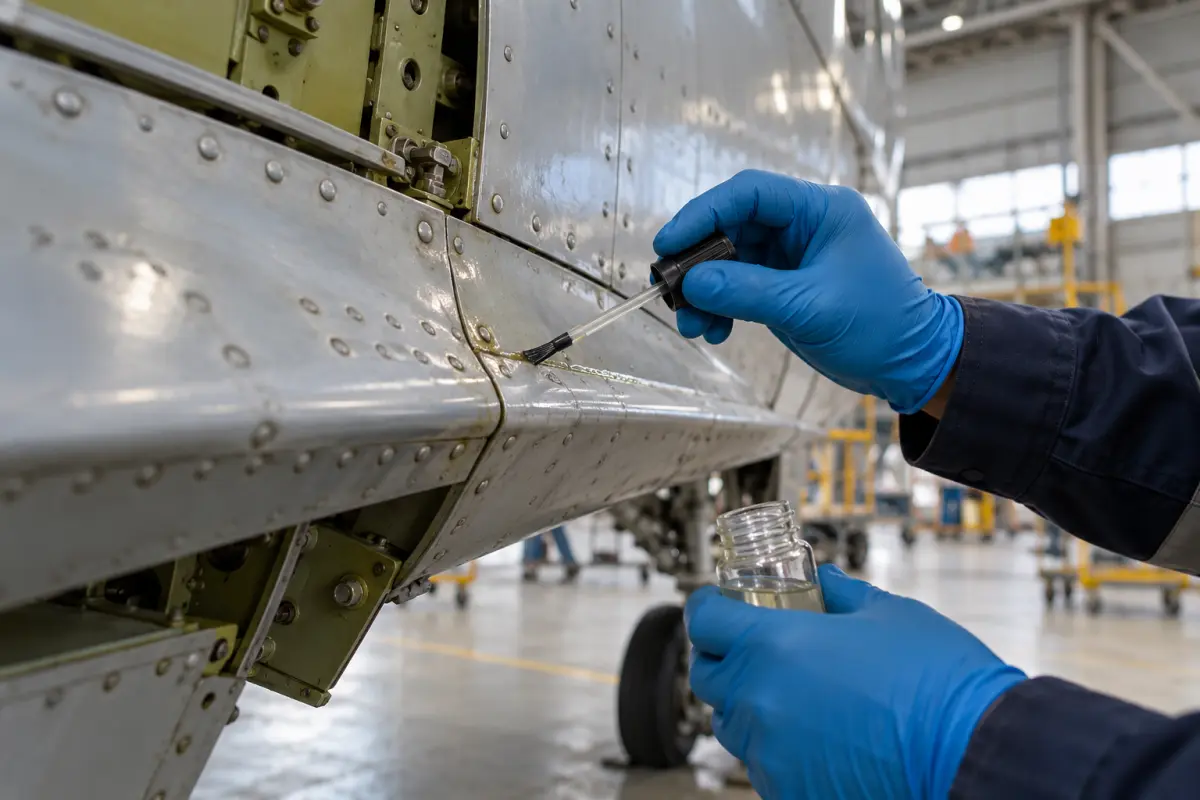
Aircraft Corrosion Inhibitor: Types, Uses and Buying Guide
An aircraft corrosion inhibitor is a material applied to a susceptible surface to help limit corrosion, typically by leaving a protective film that separates the surface from moisture and other contaminants. For MRO buyers, the key distinction is not simply whether a product inhibits corrosion, but where it will be used, what film it leaves, and whether its format matches the maintenance task.
Key Takeaways
- Corrosion inhibiting compounds, or CICs, can leave tack-free or waxy protective films; those finishes are not interchangeable by default.
- Liquid and aerosol versions of a product family have different part numbers and should be identified separately on a purchase request.
- Water displacement, penetration and film type are useful comparison points, but the intended application determines the selection.
- A corrosion inhibitor supplements a maintenance process; it does not repair existing metal damage.
What an Aircraft Corrosion Inhibitor Does
Aircraft metal structures encounter moisture through rain, condensation, wash water and changes in operating environment. Moisture can remain in joints, seams and other areas that are difficult to reach during routine cleaning. A corrosion inhibitor helps protect an accessible surface by depositing a barrier film. Some formulations are also described as penetrating or water-displacing, which can matter when treating interfaces where moisture may collect.
The term covers more than one kind of material. A sprayable CIC for an airframe cavity, a heavier waxy compound for a component and a protective material for stored metal parts may all be called corrosion inhibitors. They should not be treated as substitutes solely because they share that label. Start with the location and purpose of the treatment, then compare the material’s film and application characteristics.
Inhibitors also serve a different role from the layers used to build a paint system. A primer is selected as part of a specified coating process, while a CIC is generally selected for the protective deposit it leaves in its designated application. Buyers comparing these categories can use this guide to aircraft primer types to keep the purchasing requirements distinct.
Compare Film Types and Product Formats
Film description is a practical first filter. A tack-free film and a waxy film both provide a protective deposit, but they present different handling and access considerations. Application format matters too: an aerosol may suit a maintenance instruction calling for a packaged spray, while a liquid may fit a process using specified dispensing equipment. The package format is part of the item being ordered, not a detail to leave for the supplier to infer.
| Example product | Source-described characteristics | Question for the buyer |
|---|---|---|
| ARDROX-AV8-LIQUID | Penetrating liquid that forms a tack-free protective film | Does the task call for this liquid part number and film type? |
| ARDROX-AV15-LIQUID | Water-displacing CIC that forms a tack-free film on painted and unpainted aerospace metal surfaces | Is water displacement specified for the intended surfaces? |
| ARDROX-AV100D-LIQUID | Thixotropic CIC that forms a waxy film; described for painted and unpainted surfaces | Does the maintenance task call for a waxy deposit rather than a tack-free one? |
| CA1000-BA1002 | Non-curing, chromate-free corrosion inhibitor described for metals and composites | Is this material specifically identified for the component and exposure? |
These descriptions identify differences; they do not establish that any two products are equivalent. For example, the source information describes ARDROX-AV8-LIQUID as leaving a tack-free film, while ARDROX-AV100D-LIQUID leaves a waxy film. That difference alone gives a buyer a reason to confirm the requested part number rather than accepting a broadly described “aircraft corrosion inhibitor.”
Match the Material to the Maintenance Task
A useful selection process begins with the job description, not a product name. Establish whether the team is treating an installed structure, protecting a removed component, or preserving an item during storage. Record the substrate and surface condition identified in the work instructions, the area’s accessibility, and whether the required protective deposit is meant to be tack-free, waxy or another specified type.
- Identify the location. A joint, cavity, exposed surface and enclosed component present different access and handling needs.
- Record the surfaces. Note whether the work area includes painted metal, unpainted metal, composites or adjacent finishes.
- Define the application method. State whether the work package calls for a liquid, an aerosol or another format.
- Capture the required film. Do not assume that a penetrating, tack-free CIC serves the same purpose as a heavier waxy compound.
- Confirm the exact item. Match the manufacturer, full part number and package description to the requisition.
For example, a team seeking a water-displacing compound that leaves a tack-free film on painted and unpainted aerospace metal surfaces might evaluate ARDROX-AV15-LIQUID. If the work instead identifies a non-curing, chromate-free material for a particular metal or composite application, CA1000-BA1002 is a different item to investigate. These are examples of how to narrow a search, not directions to replace a specified material.
Maintenance caution: Use only materials and methods permitted by the applicable aircraft maintenance documentation, including any required approvals or substitution procedures, and follow the manufacturer’s current data sheet for preparation, application and handling. A protective film does not establish airworthiness or replace corrosion inspection, evaluation and repair.
Write a Purchase Request That Avoids Ambiguity
“Aircraft corrosion inhibitor” is a useful search term, but it is too broad for a precise requisition. Similar names can refer to distinct products, and a liquid and aerosol bearing the same family name remain separate ordering items. A clear request gives procurement a verifiable identifier and gives engineering a chance to check that the requested material matches the work package.
For example, a buyer could write: “Please quote CHEMETALL ARDROX-AV8-LIQUID, part number ARDROX-AV8-LIQUID, for the application identified in our maintenance work package. Please identify the offered package description and provide the product documentation needed for our review.” If the requirement is for the aerosol instead, the request should name ARDROX-AV8-AEROSOL explicitly rather than saying only “AV8.”
Where the requisition permits an alternative, state who must review it and request the proposed manufacturer and exact part number. Keep the required product separate from any suggested substitute in the purchasing record. This makes it easier to compare quotes without mistaking a shared product family, general description or intended use for confirmation that two materials are the same.
Check the Details Before Comparing Quotes
Before evaluating an offered item, compare its complete identifier against the requested one. Verify the format, manufacturer and package description, then confirm that any accompanying documentation refers to that exact item. This is particularly important when a product family includes both liquid and aerosol versions or when several CICs share terms such as “penetrating” and “tack-free.”
It also helps to separate procurement questions from engineering questions. Procurement can establish what item is being offered and what documentation accompanies it. Engineering or the organization’s designated reviewer determines whether the material is suitable for the specified task. That division prevents a general product description from being treated as an authorization to use a material on an aircraft.
Sourcing from CraftJetAero
Buyers can request a quote from CraftJetAero by part number. Include the manufacturer, required format and any package or documentation details your purchasing process needs so the request identifies the intended aircraft corrosion inhibitor.
Frequently Asked Questions
What is an aircraft corrosion inhibitor?
It is a material used to help limit corrosion on a susceptible surface, commonly by leaving a protective film. The appropriate material depends on the location, surfaces and specified maintenance process.
What does CIC mean in aircraft maintenance?
CIC means corrosion inhibiting compound. The term describes a product category, not one uniform film type or a universal substitute for every corrosion-protection task.
Is a tack-free film the same as a waxy film?
No. Both can be protective deposits, but their described finishes differ, so buyers should preserve the film requirement and exact part number when sourcing a material.
Can I order an aerosol when the request specifies a liquid?
Not without confirming that the change is permitted for the task. Liquid and aerosol formats have separate part numbers and should be identified separately in a requisition.
Does applying an inhibitor remove existing corrosion?
No. An inhibitor is a protective material, not a repair for metal that has already been damaged; existing corrosion requires evaluation through the applicable maintenance process.