
Aerospace Epoxy Adhesive: Types, Selection and Sourcing
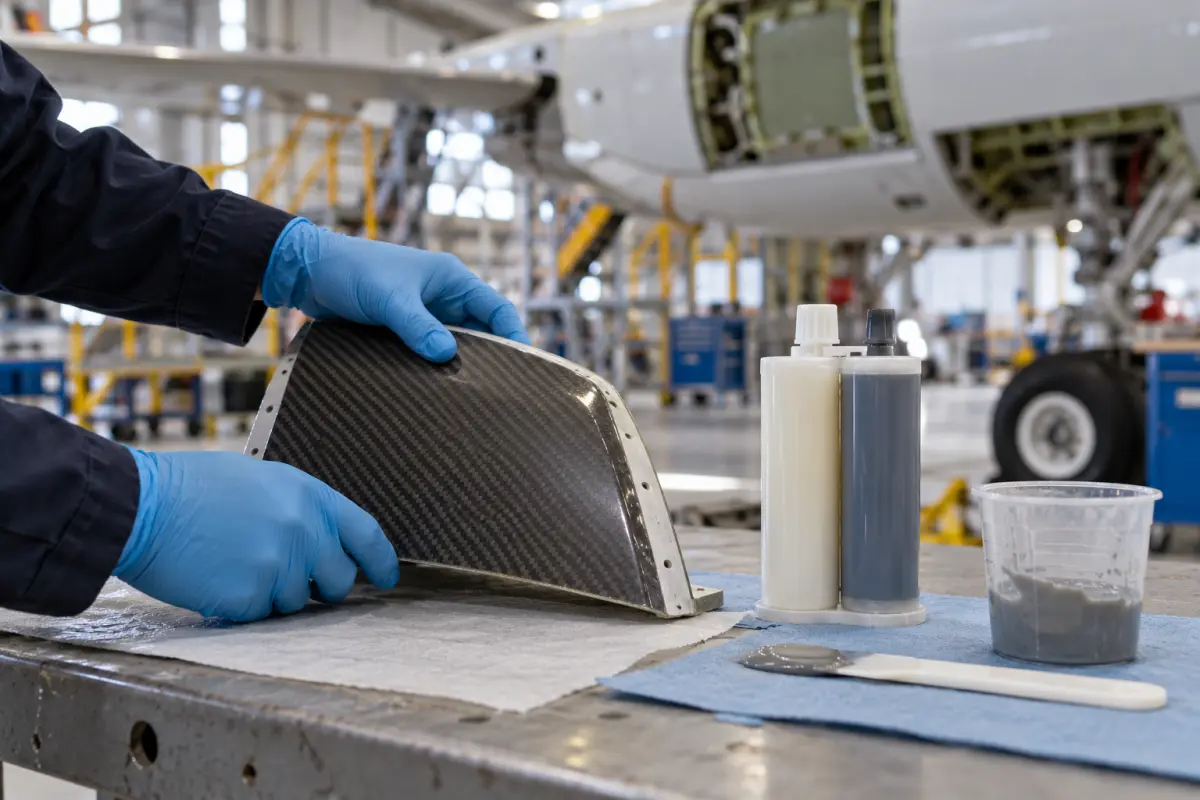
An aerospace epoxy adhesive is an epoxy-based bonding material used in aircraft manufacturing or maintenance where the specified repair or assembly calls for an adhesive. It may be supplied as a two-part liquid or paste, or as a sheet for a defined application; the correct choice depends on the materials being joined, the joint design, the cure process and the applicable maintenance instructions.
Key Takeaways
- “Aerospace epoxy adhesive” describes a material family, not a single interchangeable product.
- Paste, liquid and sheet adhesives suit different application methods and joint geometries.
- Cure conditions and material compatibility are as important to a purchase request as the part number.
- Buyers should identify the exact product, package configuration and documentation needed before requesting a quote.
What Is an Aerospace Epoxy Adhesive Used For?
Epoxy adhesives create a bond between prepared surfaces as the resin system cures. In aviation, the potential applications range from component assembly to composite work and honeycomb-related bonding. An adhesive that is appropriate for one of those tasks is not automatically suitable for another: the bonded materials, joint geometry, loading and available cure equipment can differ substantially.
For example, bonding a fitting to a prepared component presents a different handling problem from placing adhesive along a honeycomb core splice. A buyer may need a material that can be dispensed into a joint, a paste that stays where it is applied, or a sheet that can be cut and positioned. Those are practical distinctions to establish before comparing products.
Epoxy adhesive also serves a different purpose from epoxy primer. A primer prepares or protects a surface as part of a coating or bonding process; it is not a substitute for the adhesive specified to form the joint. Procurement descriptions should state the required product type rather than using “epoxy” alone.
Common Forms and How They Differ
Product form affects storage, preparation, placement and cure planning. The examples below illustrate distinctions found in the supplied product descriptions; they are not a list of interchangeable alternatives.
| Form or example | Described characteristics | Practical sourcing question |
|---|---|---|
| Two-part epoxy: 3M SCOTCH-WELD-EC-2216-B/A-GREY | Described as flexible and resistant to vibration and moisture, with a room-temperature cure and optional heat acceleration. | Is this the exact adhesive identified for the joint, and what mixing and cure instructions apply? |
| Two-component paste: Huntsman ARALDITE-2011 | A paste described as having a long working life, low shrinkage and room-temperature cure. | Does the application call for paste placement, and which kit configuration is required? |
| Application-specific adhesive: Huntsman ARALDITE-1570FST-A/B | A halogen-free, flame-retardant epoxy described for bonding PE foam to phenolic GRP in cargo areas. | Do the specified substrates and application match the purchase requirement? |
| Sheet adhesive: Solvay FM490A | A core splice adhesive sheet described for honeycomb splicing, localized reinforcement and edge bonding; its listed curing window is 225°F to 350°F (107°C to 177°C). | Is a sheet material required, and can the specified cure process be performed? |
Sheet adhesive is not simply paste adhesive in a different package. It changes how material is cut, positioned and processed. If a drawing instead calls for a structural adhesive film, treat that as a separate material-selection question; the structural adhesive film selection guide explains that category in more detail.
How to Narrow a Product Requirement
Start with the approved repair, assembly drawing or material callout, then translate its requirements into a procurement description. If an exact part number is specified, preserve it rather than substituting a broad phrase such as “aircraft epoxy.” If the request is still at the evaluation stage, separate the questions below so engineering and purchasing are working from the same requirements.
- Substrates: Identify what is being joined, such as a particular metal, composite, foam or core material. State any surface treatment called out for the work.
- Joint and loading: Describe whether the work involves an assembly bond, localized repair, panel area, edge bond or core splice. Geometry affects how adhesive can be placed and held during cure.
- Material form: Specify whether the task requires a liquid, paste, sheet or another defined presentation. Include the required kit or package configuration if known.
- Cure capability: Identify whether the job allows room-temperature curing or requires controlled heating, and whether the available equipment supports the prescribed process.
- Traceability needs: Note the documentation and identification the receiving team must check against the purchase order and maintenance records.
Do not infer suitability from a product’s general description or from the fact that it is marketed for aerospace use. Follow the aircraft maintenance documentation and the manufacturer’s current data sheet, including preparation, mixing, application and cure instructions; confirm required approvals and airworthiness applicability through the authorized engineering process before use.
Handling and Cure Questions to Resolve Before Ordering
For a two-part adhesive, the purchasing decision extends beyond the name on the label. The user needs the correct components and package format, while the work team needs a process that matches the manufacturer’s instructions. Ask whether mixing is manual or performed with the specified dispensing equipment, how the mixed material will be placed, and how the joint will be held during cure.
Working life, fixture time and full cure are different concepts. Working life concerns how long mixed material remains usable under stated conditions. Fixture time concerns when a bonded assembly can be handled for a particular purpose; full cure concerns the prescribed cure process. None should be assumed from a statement that a product “cures at room temperature.” Obtain the current data sheet when those details affect work planning.
For a sheet material, ask how pieces will be sized and positioned and what heating process the task requires. FM490A’s listed curing window, for example, makes cure capability an immediate screening question. A room-temperature-curing paste may present a different equipment requirement, but that difference alone does not establish that it is an acceptable replacement for a sheet adhesive.
What a Useful RFQ Looks Like
A specific request for quotation (RFQ) reduces clarification cycles and helps the seller identify the intended item. A practical example is: “Please quote PN ARALDITE-2011, two-component epoxy paste, in the required 2-kg kit configuration. Confirm the exact product identification and provide the manufacturer documentation available for review. Our purchase order will state the receiving documentation requirements.” This identifies a sourced part number and configuration without claiming that the material is approved for a particular aircraft repair.
When the exact number is not yet established, ask engineering to resolve the material callout first. A request such as “epoxy adhesive for a composite panel” omits the joint specification, form and cure process needed to distinguish candidates. If a proposed alternative is being considered, list the specified item and the proposed item separately so the change can be evaluated rather than silently treated as an equivalent.
Keep the RFQ, supplier response and receiving checks aligned. Record the manufacturer’s part number as written, the required quantity and package format, and any documentation the organization requires. This gives procurement a clear basis for comparing a quote with the original request without turning the supplier’s product description into an engineering authorization.
Sourcing from CraftJetAero
Buyers can request a quote from CraftJetAero by part number. Include the exact adhesive identifier, required configuration, quantity and documentation requirements so the request can be reviewed against the intended product.
Frequently Asked Questions
Is every aerospace epoxy adhesive a structural adhesive?
No. “Epoxy” identifies a material family, while structural suitability depends on the specific product, joint and applicable engineering instructions. Do not treat the terms as interchangeable.
Can a room-temperature-curing epoxy replace a heat-cured sheet adhesive?
Not on the basis of cure temperature alone. The products can differ in form, placement and intended application, and any substitution requires evaluation against the governing material callout.
Why does package configuration matter when buying a two-part epoxy?
The configuration determines how the components are supplied and may affect the planned mixing and dispensing method. State the required kit or package format alongside the part number.
What information should accompany an aerospace epoxy adhesive RFQ?
Provide the exact part number when available, quantity, package configuration and receiving documentation requirements. For an evaluation request, also identify the substrates, joint type and cure constraints.
Is epoxy adhesive the same as epoxy primer?
No. An adhesive is selected to form a bond between surfaces; a primer has a different role in surface preparation or a coating system. The word “epoxy” alone does not identify which product is needed.